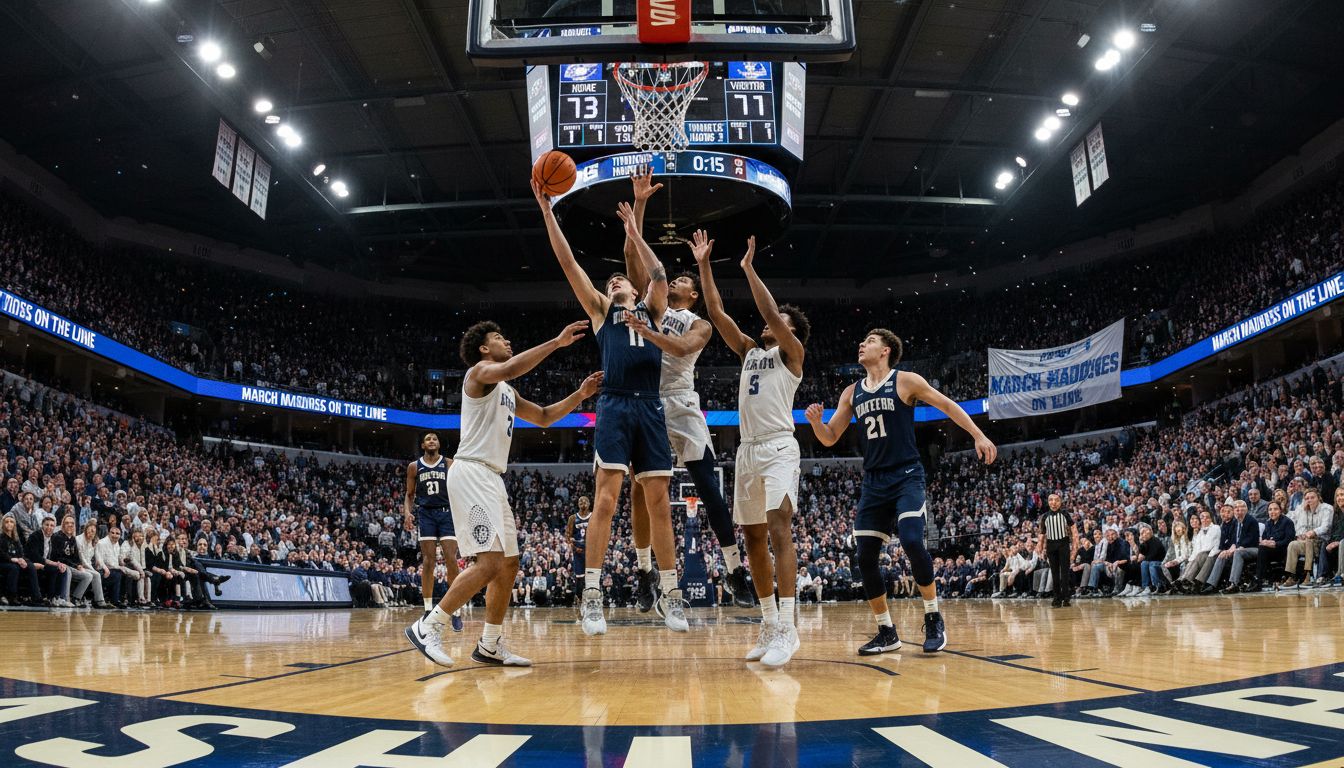
Every March, we get flooded with talk about destiny, momentum and "teams you don't want to see in your region." As someone who literally ran regressions on bracket outcomes for fun in grad school, I can tell you that the Selection Committee is far more boring than that narrative suggests. They are, at their core, bookkeepers: they count who you beat, where you beat them and how many landmines you stepped on along the way. Tuesday's bubble slate is a perfect illustration of that, featuring teams like TCU and UCLA chasing one more high-value data point while others like VCU and Virginia Tech are mostly trying to avoid catastrophic entries on the ledger. Strip away the drama, and what you have is a night of expected value calculations disguised as college basketball games.
Start with the headliners: TCU traveling to Texas Tech and UCLA hosting Nebraska, both true Quad 1 opportunities in the late-season window where each win is worth more psychologically than mathematically. TCU already owns quality wins over Florida, Wisconsin and Iowa State, which gives them a reasonably resilient profile heading into Lubbock. Add a road win over a top-10 Texas Tech team, and their Wins Above Bubble (WAB) number, already in the low 40s, likely jumps into the 30s and turns them from "Last Four In" to "basically safe unless they set the conference tournament on fire in the wrong way." This is not magic; it is simply the compounding effect of stacking multiple high-end results with no recent bad losses. If you're building an at-large case like a portfolio, TCU just needs one more blue-chip stock to lock in its position.

UCLA is in a slightly different but equally tractable spot, sitting as a projected No. 10 seed with wins over Illinois and Purdue already on the resume. From a data standpoint, that pair of victories is the equivalent of having two elite anchors in a noisy dataset: they stabilize your profile even when some of the other inputs are mediocre. Beating Nebraska, another top-15 level opponent, would give the Bruins a third marquee result and make it extremely difficult for the committee to justify excluding a 20-win Big Ten team with that triumvirate of scalps. You don't need to believe in clutch or narrative here; you just need to understand that selection systems struggle to ignore multiple correlated indicators of high-end performance. In plain English, three top-15 wins is the sort of thing that survives a bad shooting night in the conference quarterfinals.
Once you get past TCU and UCLA, the rest of the bubble board looks less like opportunity and more like risk management. VCU against George Mason, undefeated Miami (Ohio) versus Toledo, and Virginia Tech hosting Boston College are all examples of what modelers call asymmetric downside: there is very little to gain and quite a bit to lose. The selection committee's framework bakes this in via the Quad system, where a home game against a struggling opponent is slotted as Quad 3 or 4 and therefore counts heavily against you if you lose while doing almost nothing for you if you win. VCU, with few high-end wins, simply cannot afford its first Quad 3 loss; Virginia Tech, already sagging after dropping five of seven, gains essentially zero upside from beating Boston College but would be functionally eliminated by a stumble. This is the quiet brutality of March: some teams are chasing dreams, others are just trying not to crash their simulations.
Seton Hall at Xavier, San Diego State at Boise State and West Virginia at Kansas State fall into a more balanced band of outcomes, where the distribution actually has some upside mass. These are Quad 1 or Quad 2 road games for teams sitting around the "First Four Out" or "Next Four Out" line, which means a win materially shifts their probability of hearing their name on Selection Sunday. The Pirates probably need to close the regular season 2-0 and then add at least one Big East Tournament win, which is a polite way of saying they burned too many possessions earlier in the year and are now paying the compounding interest. San Diego State is a fascinating case for the numbers crowd: strong in predictive metrics like KenPom and Torvik but thinner in actual resume value, which exposes the tension between how good a team is and what it has actually done. If the Aztecs can add a road win at Boise State and then close with UNLV, they start to align process with outcomes, which is where the committee usually, if imperfectly, tries to land.
On the other end of the spectrum, you have teams like Auburn and Texas A&M, whose paths to the bubble are paved with volatility rather than consistency. Auburn sits at 15-14, which looks pedestrian until you realize they own wins over St. John's, NC State, Arkansas, Florida, Texas and Kentucky – six victories over teams currently projected in the field. Normally, that kind of top-end profile would pull a team well inside the bubble, but a recent Quad 3 home loss to an Ole Miss team that had dropped 10 straight acts like a negative outlier dragging down the entire dataset. Texas A&M, once leading the SEC, has fallen back to the pack by losing six of eight, and without a robust nonconference resume, the Aggies now find themselves trying to dig out of a hole that basic probability theory told us was coming. When you rely on winning a disproportionate number of coin-flip games, the regression monster usually shows up by February, even if the press releases pretend to be surprised.

If there's a shared theme across this entire bubble cohort, it's that the margins are being determined less by "who gets hot" and more by who avoided stepping on the wrong rakes over four months. Miami (Ohio) is undefeated, yet still under intense scrutiny because its schedule strength leaves evaluators wondering how translatable that record really is against NCAA Tournament-level opposition. West Virginia, by contrast, has enough exposure to high-end Big 12 competition that a late win over BYU can suddenly revive a profile that looked flatlined a week earlier. Virginia Tech hangs around the conversation not because it's surging, but because nobody in its immediate neighborhood has put together a coherent, data-driven case to slam the door. If that feels less romantic than the usual March storylines, that's because reality tends to be less cinematic than the hype videos.
From a "data over ideology" standpoint – and yes, I am aware that in college hoops discourse, eye test is an ideology – the committee's job on nights like this is simply to update posterior beliefs. Every result moves a team a little up or down in the pecking order based on calibrated priors: quality wins, bad losses, predictive metrics and the all-important context of where and when games were played. TCU beating Texas Tech on the road, or UCLA taking down Nebraska, are high-information events that meaningfully change those posteriors; VCU handling George Mason at home is a low-information event that mostly confirms what we already thought. When you watch these games, you're not really witnessing committee members "changing their minds" in some dramatic fashion; you're watching them quietly nudging probabilities on a very large decision tree. The fact that this gets repackaged as chaos and drama every March is less a reflection of the process and more a commentary on our collective attention span.
So how should you, the rational fan, approach a night like this? First, mentally separate games with genuine upside from those that are essentially loss-avoidance exercises; their emotional weight may feel similar, but their mathematical impact is very different. Second, be skeptical of any narrative that treats a single late-season win as erasing an entire winter of mediocrity – the committee, for all its flaws, does not reboot its spreadsheets every Tuesday. Third, recognize that teams like TCU and UCLA are not making their cases in a vacuum; Seton Hall's performance at Xavier, San Diego State's swing at Boise State and Auburn's attempt to offset that Ole Miss loss are all interconnected in the bubble ecosystem. If you can hold all of that in your head and still enjoy the games, congratulations: you're watching March like a front-office analyst instead of a character in a commercial about belief.
In the end, Tuesday's slate is less about crowning heroes and more about sorting portfolios. Some teams will add a valuable asset, some will merely avoid a downgrade and a few will trigger the equivalent of a margin call on their at-large hopes. TCU and UCLA have the clearest paths to de-risk their March, while everyone from VCU to Virginia Tech to Auburn is trying to keep bad variance from becoming a season-defining story. As always, the numbers will be brutally indifferent to who "deserves" a bid – they only care about what actually happened, not what would have happened if that one three had rimmed out in January. If that sounds cold, remember: the alternative is letting ideology and narrative do the heavy lifting, and we've all watched enough badly-seeded brackets to know how that movie ends.